



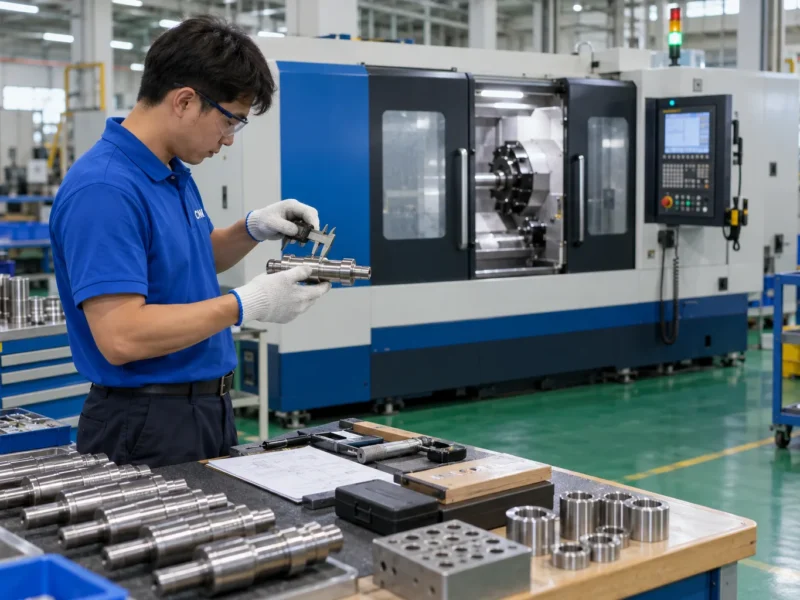
CNC milling and CNC turning are the two core machining processes. Both remove material from a solid blank under computer control, but they move the tool and the part differently. That difference decides which shapes each process makes well and what they cost.
How they work
CNC milling: the part is clamped on the table and a rotating cutter moves around it. 3-axis machines move the tool in X, Y and Z; 4-axis and 5-axis machines also tilt or rotate the part, so more faces can be machined in one setup.
CNC turning: the part rotates in a chuck or collet and a stationary tool cuts it, on a lathe. Turning produces round features (diameters, faces, grooves and threads) quickly, and diameters cut in one clamping stay concentric. Turning centers with live tooling (mill-turn) can also mill flats and drill cross holes.
Comparison
| CNC milling | CNC turning | |
|---|---|---|
| Part shape | Prismatic: blocks, plates, housings | Round: shafts, pins, bushings |
| Typical features | Pockets, slots, faces, hole patterns, 3D surfaces | Diameters, tapers, grooves, threads, faces |
| Setup | Fixtures or vises; several setups for many faces | Chuck or collet; often one or two operations |
| Speed on round parts | Slower | Faster |
| Concentricity | Harder to hold between setups | Easy to hold in one clamping |
| Stock | Plate, block or bar | Round or hex bar |
Typical, simplified comparison.
A quick way to decide
- Is the part mostly round, with features around an axis? Turn it, and add milled features on a mill-turn machine if needed.
- Is the part mostly flat or box-shaped, with features on several faces? Mill it; use 4- or 5-axis milling to reduce setups.
- Is it long, slender and small in diameter? Consider Swiss-type turning.
- Does it have both? Many parts are turned first and then milled, or made complete on a mill-turn center.
How the choice affects cost
The biggest cost drivers are machine time and the number of setups. A shaft milled from a block wastes material and time; a housing forced onto a lathe needs awkward fixturing. Matching the process to the shape is the first step to a lower price. See what drives CNC machining cost.
Frequently asked questions
What is mill-turn machining?
A mill-turn center combines a lathe with live, rotating tools, so a part can be turned and milled in one setup. It reduces handling and keeps milled features accurate to the turned diameters.
Is 5-axis milling always better?
No. It pays off on parts with features on many faces or freeform surfaces. Simple plates and blocks are often cheaper on a 3-axis machine.
Can the same part be made either way?
Sometimes. A short round flange can be turned or milled; turning is usually faster, while milling may be chosen if the flange has many off-axis features.
Have a part to quote? Send your 3D model and drawing through our inquiry form. An engineer reviews it and replies with a quotation and any design suggestions.