



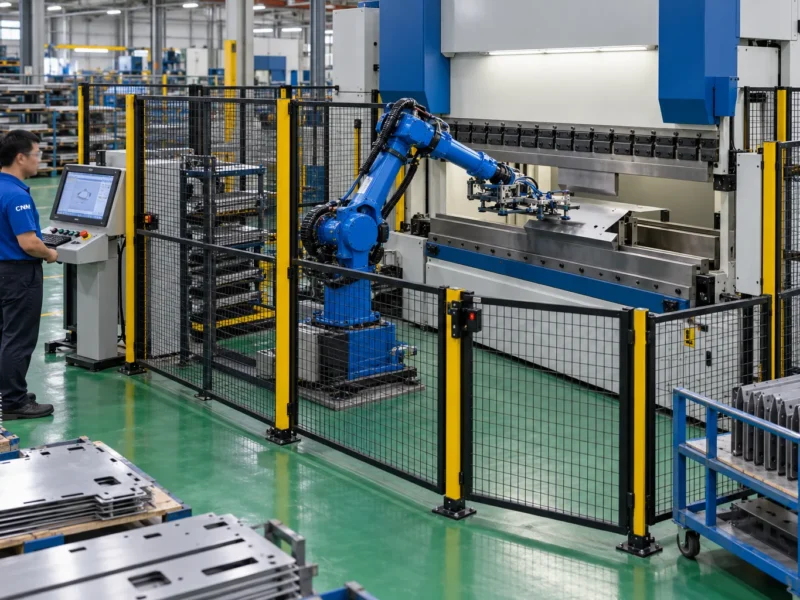
Sheet metal parts are economical when they are designed for the way sheet is cut and bent. These rules are typical starting points used by fabricators; the exact values depend on material, thickness and tooling.
Design rules
| Feature | Typical guideline | Why |
|---|---|---|
| Thickness | One thickness for the whole part | A part is made from one sheet |
| Inside bend radius | About equal to the material thickness; the same radius on all bends | Standard tooling, fewer setups, less cracking |
| Minimum flange length | At least about 4 times the thickness | The flange must rest on the die while bending |
| Hole to bend distance | At least about 2.5 times the thickness plus the bend radius | Holes too close to a bend distort |
| Hole diameter | Not smaller than the thickness | Smaller holes are hard to punch or cut cleanly |
| Hole to edge distance | At least about 1.5 to 2 times the thickness | Prevents bulging and tearing |
| Bend reliefs | Add reliefs where a bend meets an edge | Prevents tearing at the corner |
| Hardware | Self-clinching nuts, studs and standoffs with their specified edge distances | Strong threads in thin sheet |
Tolerances
Laser-cut features in one flat piece are typically within about ±0.1 mm of each other. Each bend adds variation: dimensions across one bend are typically about ±0.2–0.3 mm, bend angles about ±1°, and the error adds up across several bends. Dimension critical features from the same face or flange where possible, and put tight tolerances only where parts mate. If two holes on different flanges must line up, make one of them a slot or cut it after bending.
Welding and finishing
- Keep welds accessible and avoid welding near cosmetic faces.
- Allow for coating thickness on fits when parts are powder coated.
- If parts are brushed, show the grain direction on the drawing.
When sheet metal is not the best answer
Very thick parts, small parts with many features, or parts needed in very large quantities may be better as CNC machined, stamped or cast parts. At high volume, a laser-cut and bent bracket often becomes a stamped one. See what drives CNC machining cost and our metal stamping page.
Frequently asked questions
What is a K-factor?
The position of the neutral axis in a bend, as a fraction of the material thickness. It is used to calculate the flat blank length when CAD unfolds the part. Typical values are 0.3 to 0.5, depending on material, bend radius and tooling; fabricators use values from their own bend tests.
Can I bend aluminum as tightly as steel?
Usually not. Harder alloys and tempers crack on tight bends and need larger radii. 5052-H32 bends well; 6061-T6 needs a much larger radius, or the part is bent in a softer temper and heat treated afterwards.
Should I send a flat pattern?
Send the 3D model; the fabricator unfolds it with their own bend data. A flat pattern is useful as a reference.
Have a part to quote? Send your 3D model and drawing through our inquiry form. An engineer reviews it and replies with a quotation and any design suggestions.