



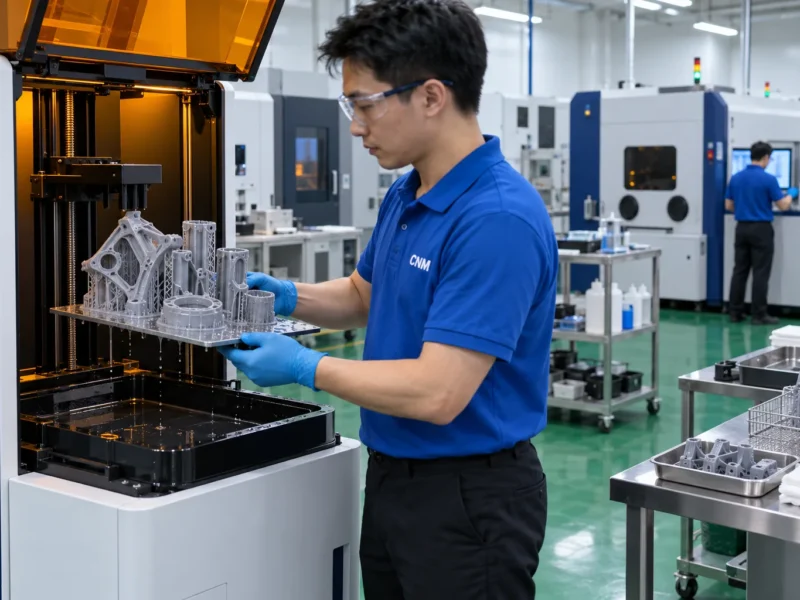
Prototype parts can be printed, machined, cast in silicone molds or molded in rapid tooling. Each route suits a different stage of development. This guide compares the first three.
Comparison
| 3D printing | CNC machining | Vacuum casting | |
|---|---|---|---|
| Tooling | None | None | Silicone mold from a master |
| Materials | Resins, nylon, some thermoplastics, metal powders | Real metals and engineering plastics | Polyurethane resins that imitate ABS, PP, PC or rubber |
| Strength | Good, can be anisotropic | Full material properties | Good, production-like |
| Accuracy (typical) | About ±0.1–0.2 mm (SLA, MJF) | ISO 2768-m by default, tighter where specified | About ±0.2–0.3 mm per 100 mm |
| Surface | Layer lines unless finished | Machined; can be polished or finished | Copies the master surface |
| Complex internal shapes | Excellent | Limited by tool access | Limited by mold opening |
| Best quantity | 1 to a few dozen | 1 to a few hundred | About 10 to 50 (15–25 per mold) |
Typical, simplified comparison.
Which to use when
- Early concept and form checks: 3D printing. It is the fastest route, needs no tooling and handles almost any shape.
- Functional tests in the real material: CNC machining, especially for metal parts or engineering plastics.
- Several look-alike samples in color or clear: vacuum casting from a printed or machined master.
- Hundreds of parts in the real plastic: rapid tooling.
Combining processes
A common route is to print an SLA master, finish it, and vacuum cast ten colored samples from it; or to machine a metal part and print its plastic cover. The parts of one assembly do not have to go the same way.
Frequently asked questions
Which is cheapest for one prototype?
Usually 3D printing, for plastic parts. For metal parts with simple geometry, CNC machining is often competitive.
Can vacuum casting make transparent parts?
Yes. Clear polyurethane resins are used for lenses, covers and light pipes, and the master is polished to give a clear surface.
Are machined plastic prototypes the same as molded parts?
They are the same material but not the same structure: molded parts have flow and cooling effects, and wall thickness rules differ. Machined prototypes are good for fit and function, less so for testing moldability.
Have a part to quote? Send your 3D model and drawing through our inquiry form. An engineer reviews it and replies with a quotation and any design suggestions.