



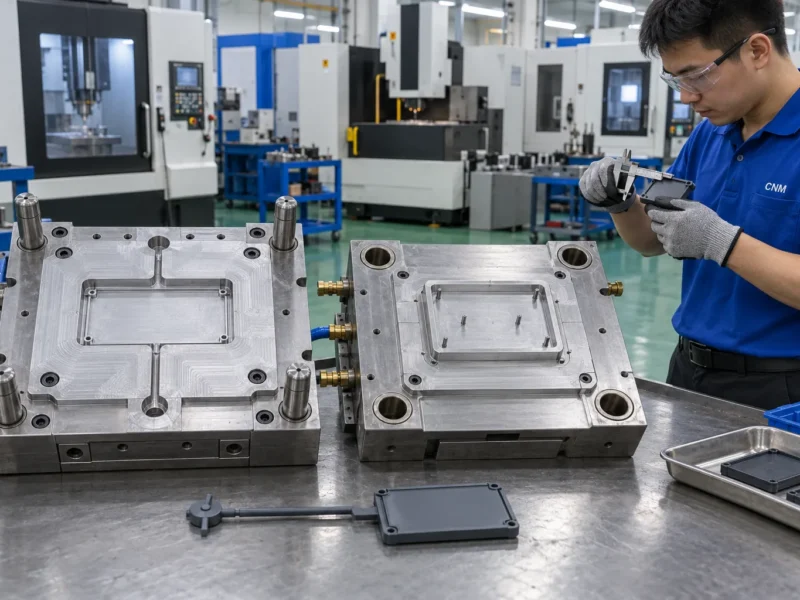
Between prototypes and full production there is often a gap: you need real molded parts in the production plastic, but the production mold is not ready, or the volume does not justify one. Rapid tooling fills that gap.
Rapid tooling vs production tooling
| Rapid tooling | Production tooling | |
|---|---|---|
| Mold material | Aluminum (e.g. 7075) or pre-hardened steel (e.g. P20, 718) | Pre-hardened or hardened tool steel (e.g. P20, 718, H13, S136) |
| Construction | Simplified; manual inserts instead of slides where possible | Full slides, lifters, cooling, often hot runners |
| Build time | Shorter | Longer |
| Mold cost | Lower | Higher |
| Mold life (typical) | A few thousand to tens of thousands of shots | Hundreds of thousands of shots and more |
| Cycle time | Often longer | Optimized |
| Part material | Production plastic | Production plastic |
Typical, simplified comparison.
When rapid tooling makes sense
- You need parts in the real plastic for testing or certification.
- You want pre-series parts for assembly trials or market tests.
- You need parts while the production mold is being built (bridge tooling).
- Lifetime volume is low and will not pay back a production mold.
When to go straight to production tooling
- The design is frozen and volumes are high from the start.
- The part needs complex actions, tight cosmetic standards or very short cycles.
- The material is abrasive (for example glass-filled) and would wear a soft mold quickly.
For plastic injection molds built for production, see China United Mould. For earlier prototypes, compare 3D printing, CNC machining and vacuum casting.
Frequently asked questions
Is "rapid tooling" the same as "prototype mold"?
In practice, yes. Both describe simplified, faster-to-build molds that make real molded parts in limited quantities.
Can a rapid tool be upgraded to production?
Sometimes the design data and lessons are reused, but the mold itself is usually replaced by a hardened production mold when volumes grow.
Can rapid tooling make parts with undercuts?
Yes, often with hand-loaded inserts rather than automatic slides, which keeps the mold simple but increases cycle time.
Have a part to quote? Send your 3D model and drawing through our inquiry form. An engineer reviews it and replies with a quotation and any design suggestions.