CNC milling
CNC milling for housings, plates and complex 3D parts
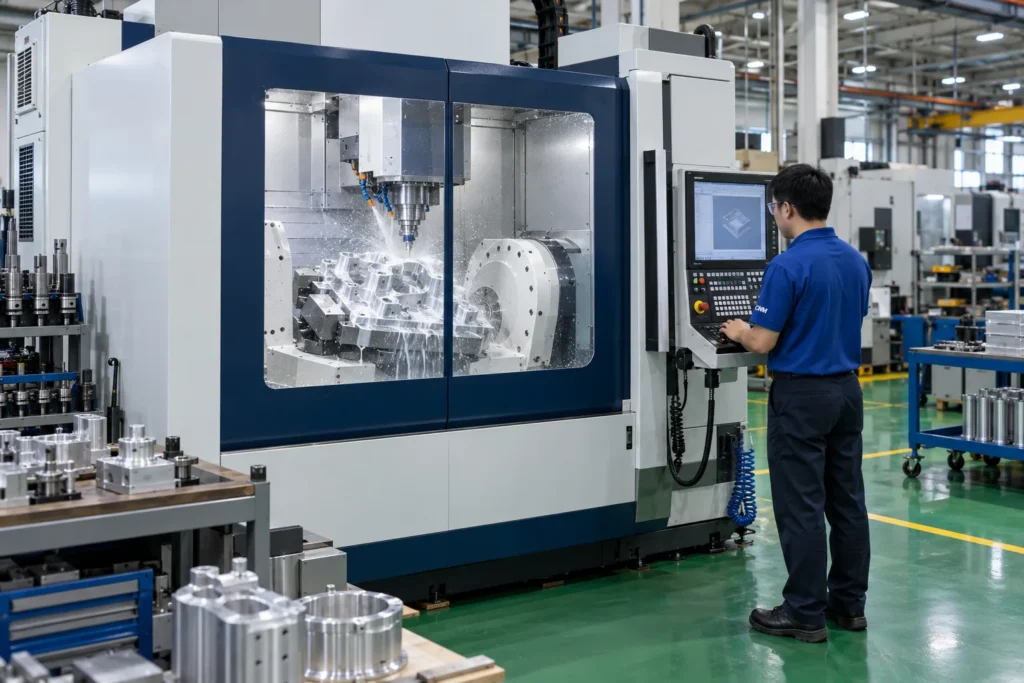
In CNC milling a rotating cutter removes material from a workpiece clamped to the machine table. Three-axis milling covers most plates, pockets and profiles. Features on other faces are reached by re-clamping the part, or by 4-axis and 5-axis machining, which tilts the part or the spindle. Fewer setups keep features on different faces in position relative to each other.
Typical milled parts: enclosures and housings, heat sinks, manifolds, brackets, fixtures, mold inserts and machined prototypes.
What CNC milling is good at
- Flat faces, pockets, slots and steps
- Drilled, tapped and reamed holes located to a datum
- 3D contoured surfaces
- Thin ribs and walls in aluminum, typically from about 1 mm
- Bores and sealing faces held to tight tolerances
- Engraved marking and fine detail
CNC milling at a glance (typical)
| Typical parts | Housings, enclosures, plates, brackets, manifolds, heat sinks, fixtures |
|---|---|
| Features | Pockets, slots, bores, threads, 3D surfaces, engraving |
| Inside corners | Radius at least the cutter radius; about one third of the pocket depth or larger keeps cost down |
| Surface roughness | Ra 3.2 µm as milled; Ra 1.6 or 0.8 µm on faces that need it |
| Materials | Aluminum, steels, stainless steel, brass, copper, titanium, plastics |
| Finishes | Anodizing, plating, powder coating, painting, polishing |
CNC milling FAQ
When does a part need 5-axis milling?
When it has features on many faces, compound-angle holes, undercuts or freeform surfaces. Five-axis machining reaches them in fewer setups, which keeps those features in position relative to each other. Simple plates and blocks are usually cheaper on a 3-axis machine.
What is the smallest inside corner radius?
A milled inside corner can be no smaller than the radius of the cutter that cuts it. A radius slightly larger than the cutter, for example R3.2 for a 6 mm end mill, machines more cleanly. Sharp inside corners need EDM or wire EDM.