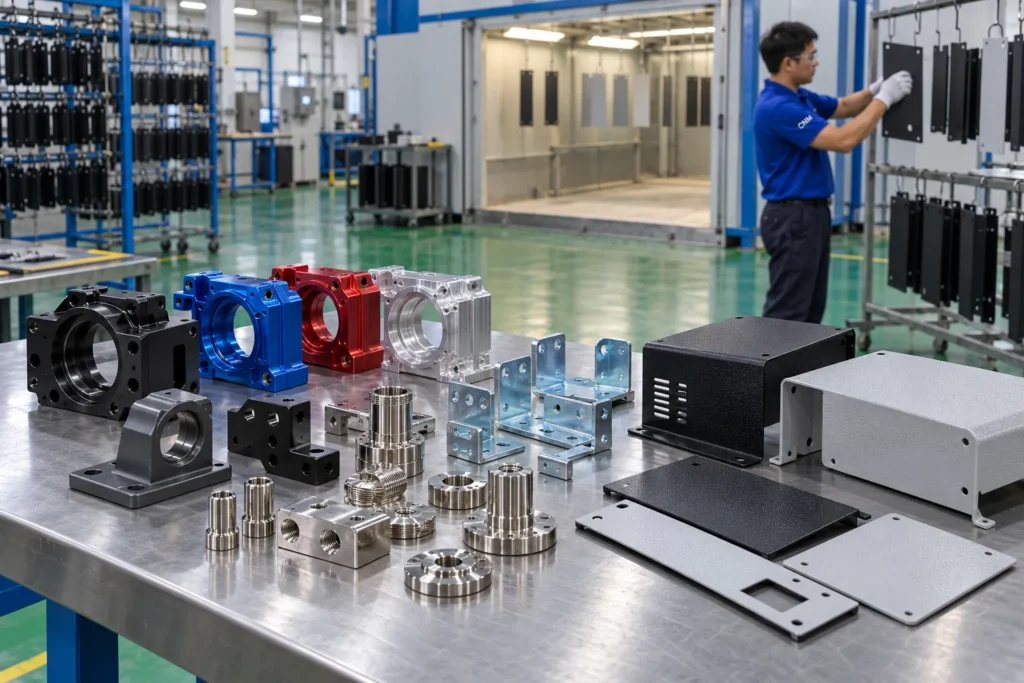
Finishing
Finishes matched to material, function and appearance
A finish protects the part, sets how it looks and feels, and changes its dimensions. Before processing we agree the masking areas, the mating surfaces, the appearance criteria and the allowance for coating thickness on fits and threads.
Finishing can be ordered with machined, sheet metal or prototype parts, or as a separate operation on your parts.
Common finishes
| Deburring and polishing | Removes burrs, sharp edges and tool marks. Polishing ranges from a satin finish to a bright, reflective surface. |
|---|---|
| Anodizing | Aluminum only. Clear or dyed decorative anodizing (Type II) is typically 5–25 µm thick; hard anodizing (Type III) typically 25–75 µm for wear resistance. |
| Electroplating | Zinc for corrosion protection of steel; nickel and chrome for wear and appearance. Typical zinc plating is 5–12 µm. |
| Powder coating and painting | Colored coatings for sheet metal and enclosures. Powder coat is typically 60–120 µm, so threads and fits are masked. |
| Passivation | A chemical treatment that removes free iron from stainless steel surfaces and restores their corrosion resistance. |
| Heat treatment | Hardening, tempering or stress relief where the drawing specifies it. |
Thickness values are typical industry ranges; the drawing or finish specification governs.
Surface finishing FAQ
Does anodizing change the dimensions of a part?
Yes, slightly. Roughly half of the anodic layer grows into the aluminum and half builds up on the surface, so a 50 µm hard-anodized layer adds about 25 µm per surface. Threads and bearing fits are masked or machined with an allowance.
Which finish protects steel parts best?
It depends on the environment. Zinc plating, powder coating and painting are common for carbon steel; stainless steel is usually passivated. If the part has to pass a salt-spray test, put the requirement on the drawing.